The charter designation for professionals who structure how family wealth passes to the next generation — wills, trusts, succession law and estate taxation. Issued from the USA, recognised across 150+ countries, and backed by a network of 300,000+ certified professionals.
Among the first charter designations in trust and estate planning worldwide.
Exams are booked through authorized testing partners across 75+ Indian cities.
Trusted & recognised worldwide
The shift
From Product Adviser to Succession Architect
Most advisers reach the same ceiling: the client has accumulated the wealth, and the conversation about what happens to it goes to someone else.
No estate planning vocabulary
Wills, trusts, gift deeds, nominations, family settlements — knowing which instrument fits which situation, and why.
Conversations stop at the portfolio
You discuss what the client owns, not how it passes on — which is where the deeper relationship sits.
Referred out to a lawyer
The mandate leaves your desk and the relationship ends there.
Competing on returns
Succession work is measured in decades, not quarters, and it retains the next generation as clients.
CTEP® is built for the point at which a client stops asking how their money grows and starts asking who it goes to.
What is the Chartered Trust & Estate Planner (CTEP®) designation?
CTEP® is a professional designation in trust, succession and estate planning, issued from the USA under the American Academy of Financial Management. It certifies that the holder can structure the transfer of family wealth across generations — drafting and reviewing wills, setting up and administering trusts, working through succession law, and planning for the tax consequences that follow. Where most financial credentials stop at how wealth is built, CTEP® starts at how it is passed on. That makes it the natural second charter for advisers, lawyers and accountants whose clients have already accumulated wealth and are now asking what happens to it.
6 units · 65 lessons
One level, one examination
45 hours of live online instruction across approximately eight weekends, 11:38 hours of recorded lessons, and a single online examination. Most candidates complete the charter in two to three months.
Who earns the CTEP®?
Practising advocates
Lawyers handling wills, probate and family settlements who want a structured financial framework behind the legal drafting.
Chartered Accountants & Company Secretaries
Professionals already advising promoter families, adding succession and estate structuring to compliance and advisory work.
Financial planners & wealth managers
Advisers whose clients have crossed the accumulation stage and are now asking about transfer, legacy and family governance.
Family office professionals
RMs serving HNI and UHNI clients who need to hold a credible conversation about trusts and estate structures
Private bankers & relationship managers
Differentiate yourself in placements before you have experience to point to.
NRI & cross-border advisers
Professionals dealing with assets, heirs and wills spread across jurisdictions — a segment CTEP® is built around.
No prior estate planning background is required. Classes are live online, so the program is open to professionals anywhere in India and abroad.
Recognized and accepted by leading institutions
Our certifications open doors to top companies across the finance industry. CTEP® is issued from the USA under the American Academy of Financial Management, a standard in place since 1996 and recognised across 150+ countries.
INDIA
INTERNATIONAL
CTEP® is delivered entirely online. Live classes run at the weekend — three hours on Saturday and three on Sunday, across approximately eight weekends — adding up to 45 hours of instruction. Every session is recorded and placed on your LMS, so a missed Saturday is not a missed module.
Alongside the live classes you get 65 recorded lessons across 6 units, running to 11 hours and 38 minutes, available for a full year. The program closes with a single online examination. Most candidates complete the charter in two to three months.
Live online instruction: 45 hours of taught classes, not a recorded-only course.
Weekend schedule: designed around a working week, so nothing collides with office hours.
Everything recorded: a full session library on your LMS for revision before the exam.
One examination: a single online paper, 50% to pass, with no multi-level sequence.
Estate planning is not a subject you can assemble from search results. The instruments interact — a trust deed drafted without regard to residual estate provisions creates a problem that only surfaces years later, usually in front of a family that has just lost someone.
Where professionals get stuck:
Instruments learned in isolation — a Will here, a trust there — with no view of how they interact
Legal knowledge without the tax consequence, or tax knowledge without the drafting
Personal law, statutory succession and testamentary succession treated as separate subjects
No structured way to run a client's estate through to a defensible plan
How the program addresses it:
Structured preparation puts the instruments in sequence, teaches you which questions to ask before drafting begins, and gives you a faculty of practising professionals to test your reasoning against. That is the difference between knowing what a trust is and knowing when to recommend one.
A complete trust, succession and estate planning skill set
Wills & testamentary instruments
Drafting, execution, registration and the common failure points that lead to contested estates.
Trust structures & administration
Private, discretionary, MWP Act and charitable trusts - formation, trustee duties and ongoing administration.
Succession & inheritance law
The statutory and personal-law frameworks that govern how estates devolve in India.
Estate & transfer taxation
Tax treatment of gifts, transfers, trust income and the estate as it passes through.
Cross-border & NRI estates
Assets and heirs across jurisdictions, FEMA repatriation, and wills that need to survive in more than one country.
Family governance & business succession
Promoter family arrangements, family constitutions, and passing on an operating business rather than a portfolio.
Your journey from enrollment to charter
No uncertainty after payment
01
Enquire
Speak to an advisor and confirm CTEP® is the right fit for your practice.
02
Enroll online
Pay securely. Registration and courseware access open for one year.
03
Get LMS access
65 recorded lessons across 6 units, available immediately.
04
Join the live batch
Weekend classes begin — three hours Saturday, three hours Sunday.
05
Complete 45 hours
Approximately eight weekends of live instruction, all recorded for revision.
06
Prepare
Revise from the session library and the recorded lesson set.
07
Register for the exam
Pay the exam fee and book your online slot.
08
Earn your CTEP® charter
Clear the examination at 50% and receive your certificate, issued from the USA.
Faculty
◆Learn from practitioners, not presenters
Dr. Deepak Jain
Director & Co-founder, AAFM® India
25+ years in wealth management and estate planning. Author of 26 books on finance; has led AAFM India to train 45,000+ individuals including 30,000+ wealth managers.
Saurabh Jain
Faculty, AAFM® India
Faculty, AAFM® India CA, CS, CFA, FRM, CFP (US), CWM®, CTEP, CISI (UK), CCRA, CIRA, AIM
A multi-credentialed finance professional bringing deep expertise across accounting, risk, wealth management and estate planning.
Himanshu Patodi
VP – HSBC Bank
CWM, CTEP, IIM-Mumbai
A transformational leader with 2 decades of experience in global premier banking, designing wealth strategies that bridge borders, insights and legacies.
The curriculum: 6 units, one level, one integrated framework
Six units taking you from the foundations of estate planning through the laws that govern succession, the drafting of Wills, the formation and administration of trusts, and finally cross-border estates. Every unit maps directly to the CTEP® certification examination.
Level-1
59 Lessons 11:38:43
Unit - 1 Introduction to Estate Planning
7 Lessons
00:39:04 Hours
Chapter 1 - Introduction to Estate planning
.
Chapter 2 - Introduction to Estate planningEstate Planning Process
.
Chapter 3 - Goal Setting
.
Chapter 4 - The Basic Tools of Estate Planning
.
Chapter 5 - Business Succession Planning
.
Chapter 6 - Philanthropy and Charitable Planning
.
1. CTEP® Orientation by Mr. Jitesh Kapoor
00:39:04
Unit - 2 Laws Affecting Estate Planning
9 Lessons
02:38:08 Hours
Chapter 1 - Introduction to Law
.
Chapter 2 - Meaning and Essentials of a Contract
.
Chapter 3 - Law of Agency
.
Chapter 4 - Formation of Companies
.
Chapter 5 - Various Acts
.
Chapter 6 - Anti Money Laundering And Due Diligence
.
Chapter 7 - Hindu Personal Law
.
Chapter 8 - Muslim Personal Law
.
2. Introduction of Chartred Trust & Estate Planner - By Mr Sudhir Sinha
02:38:08
Unit - 3 Personal & Intestate Succession Laws in India
14 Lessons
02:45:35 Hours
Chapter 1 - Introduction
.
Chapter 2 - Indian Succession Act, 1925
.
Chapter 3 - Hindu Succession Act
.
Chapter 4 - Coparcenary Property Under HSA
.
Chapter 5 - Succession in Case of Males Under HSA
.
Chapter 6 - Succession in Case of Females Under HSA
.
Chapter 7 - Minority and Guardianship Act 1956
.
Chapter 8 - The Hindu Adoption and Maintenance Act, 1956
.
Chapter 9 - Mitakshara and Dhayabaga Schools of Hindu Law
.
Chapter 10 - Muslim Law
.
Chapter 11 - Gifts Under Muslim Law
.
Chapter 12 - Wakfs Under Muslim Law
.
Chapter 13 - Goa Civil Code
.
3- Chartered Trust Estate Planner CTEP By Dr. Deepak Jain
02:45:35
Unit - 4 Wills and Testamentary Succession
14 Lessons
02:40:07 Hours
Chapter 1 - Introduction to Testamentary Succession
.
Chapter 2 - Eligibility and Capacity to Make a Will
.
Chapter 3 - Different Types of WILLS
.
Chapter 4 - Execution, Attestation and Registration of Wills
.
Chapter 5 - Revocation, Alteration and Revival of Wills
.
Chapter 6 - Beneficiaries and Bequests Under a Will
.
Chapter 7 - Property Subject to Testamentary Disposition
.
Chapter 8 - Probate and Letters of Administration
.
Chapter 9 - Drafting a Legally Valid Will
.
Chapter 10 - Special Considerations for Testamentary Succession
.
Chapter 11 - NRI Wills
.
Chapter 12 - Executing a Will
.
Chapter 13 - Tax Implications of Succession
.
4. Chartered Trust Estate Planner CTEP By Dr. Deepak Jain
02:40:07
Unit - 5 Trust Planning in India
10 Lessons
02:55:49 Hours
Chapter 1 - Foundations and Legal Framework
.
Chapter 2 - Creation and Management of Trusts
.
Chapter 3 - Managing Trust Property and Assets
.
Chapter 4 - Trust for UnBorn Person and other Relatives
.
Chapter 5 - Regulatory and Compliance Considerations
.
Chapter 6 - Oral and Specific Beneficiary Trusts
.
Chapter 7 - Religious and Charitable Trusts
.
Chapter 8 - Practical Considerations and Advanced Topics
.
Chapter 9 - Modern Challenges and Future Considerations
.
5. Chartered Trust Estate Planner CTEP By Dr. Deepak Jain
02:55:49
Unit - 6 International Estate Planning
5 Lessons
00:00:00 Hours
Chapter 1 - Estate Planning in Singapore
.
Chapter 2 - Estate Planning in the UK
.
Chapter 3 - Estate Planning in the US
.
Chapter 4 - Estate Planning in the UAE
.
Chapter 5 - FEMA Regulations in Estate Planning
.
Our alumni work at India's leading wealth institutions
CWM® charterholders serve in private banking, wealth advisory, financial planning,
and portfolio roles across these organizations — part of a 300,000+ global alumni network.
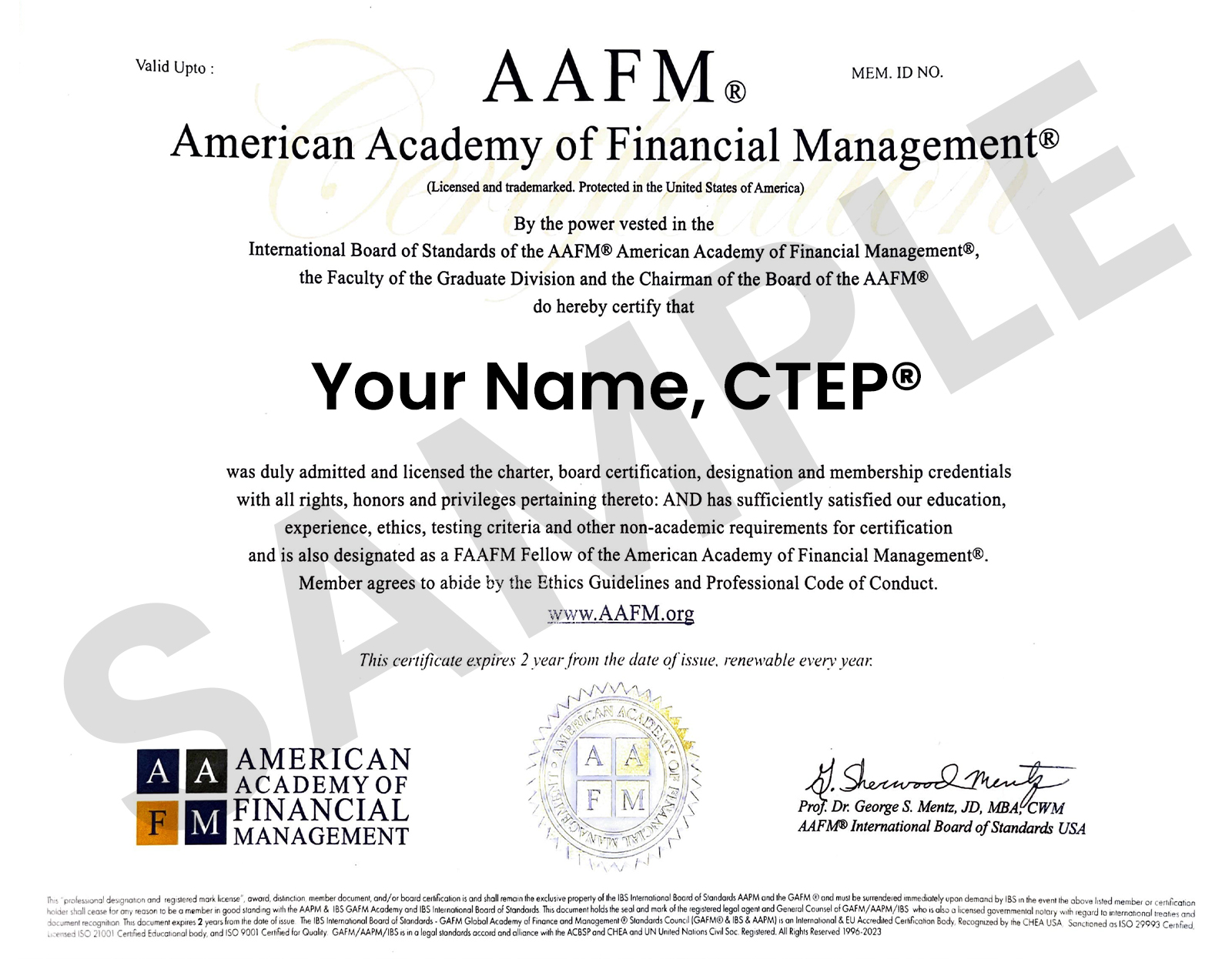
Your charter - tangible, verifiable, yours
Verified in seconds
Every CTEP® charter can be verified online by employers and clients at AAFM India's official verification page. Your designation is a credential, not a claim - and verification is what separates the two. Use the CTEP® mark after your name on your resume, LinkedIn, business card, and client communication. CertificationValidityChecks
One level, one charter
Eligibility
Who can enroll
Anyone who has passed 12th grade can register. Graduation in any stream is required before the certification is conferred, so final-year students can enrol now.
No prior background needed
The curriculum builds the law from the ground up in a practical, case-based way. No legal or accounting background is required.
Open to professionals anywhere
Classes and the examination are both online, so the program is open across India and abroad. The certification is recognised in 150+ countries.
Earn it, don’t buy it
The certification exams
Question
Answer
Examinations
One. CTEP® is a single-level charter — there is no multi-level sequence.
Mode
Online
Passing score
50%
Eligibility
Register after 10+2. Graduation in any stream is required for the certification to be awarded.
Certificate
Issued from the USA under AAFM® international standards.
Exam fees — payable separately at booking
Exam
Fee
GST
Payable at booking
CTEP® certification examination
₹5,000
₹900
₹5,900
The examination fee is not included in the program fee and is paid at the point of exam registration.
The counsellor call, replaced
Frequently asked questions
Everything you'd normally ask a counselor, answered here.
About CTEP®
CTEP® stands for Chartered Trust and Estate Planner. It is a professional certification in trust and estate planning awarded by the American Academy of Financial Management (AAFM®). In India, the program is delivered by AAFM India. It covers wills, trusts, succession planning, estate taxation and the transfer of wealth across generations.
The CTEP® certification is awarded by the American Academy of Financial Management (AAFM®), established in 1996. AAFM India is the Indian chapter of AAFM® USA and runs the program in India. AAFM has certified over 300,000 professionals across its programs and works with 800+ university partners.
Yes. AAFM certifications are valid in 150+ countries, and AAFM has direct presence in 17 countries. CTEP® is among the first charter designations in trust and estate planning worldwide. The credential travels with you if you move or work with international clients.
CTEP® is for professionals who work with wealth, trusts, and estate planning. This includes trust officers, family office managers, private bankers, wealth managers, and financial planners.
It also suits investment advisors, portfolio and asset managers, investment analysts, hedge fund managers, stock market professionals, and brokerage and market analysts.
On the business side, it works well for retail branch managers, heads of financial accounts, operations and planning managers, and financial marketing professionals.
In short, if your work involves advising clients on their wealth, managing their assets, or planning how it passes to the next generation, CTEP® adds a specialist edge to your profile.
Unit 1 — Introduction to Estate Planning
Unit 2 — Laws Affecting Estate Planning
Unit 3 — Personal and Intestate Succession Laws in India
Unit 4 — Wills and Testamentary Succession
Unit 5 — Trust Planning in India
Unit 6 — International Estate Planning
CTEP® builds four practical skills: intergenerational wealth transfer, wealth preservation, trust and succession structuring, and estate and gift tax planning. You learn to advise families on how wealth moves to the next generation and how to structure it so it holds. For an advisor, this turns a portfolio conversation into a legacy conversation.
Eligibility
You can enrol in CTEP® after Class 12. To receive the CTEP® charter, you need to be a graduate. So you can start studying while you finish your degree, but the designation is awarded only once your graduation is complete.
Yes. Class 12 is enough to enrol and study. You can complete the six units and take the exam. The CTEP® charter itself is awarded once you graduate, so final-year students often start early and receive the designation soon after their degree.
No. CTEP® does not require a law degree or an accounting qualification. The program teaches the legal, tax and structural side of estate planning from the ground up. A background in finance, banking or advisory helps you move faster, but it is not a condition for enrolment.
Format and duration
CTEP® is fully online. There is no classroom requirement. AAFM India offers two modes of learning:
Self-paced — you get recorded video lectures and study on your own schedule.
Live online — interactive weekend classes with a faculty member, three hours on Saturday and three hours on Sunday.
You pick the mode that fits your work schedule.
Choose self-paced if your work hours are unpredictable, you want to move faster than a weekend schedule allows, or you want the lower fee — self-paced costs ₹46,020 against ₹76,700 for live online. Choose live online if you want to ask questions in real time, discuss cases with faculty, and keep to a fixed weekly rhythm. Live sessions are recorded too, so missing a weekend does not set you back. Both modes cover the same six units and lead to the same CTEP® certification.
CTEP® live online classes run on weekends — three hours on Saturday and three hours on Sunday. AAFM India runs several batches in parallel, so timings vary by batch. Speak to a counsellor to pick the batch that fits your schedule. The weekend format means you do not have to take leave from work.
Every live session is recorded and stays on your LMS. If you miss a weekend class, you can watch the recording whenever it suits you. The recordings also stay available through your registration period, so you can go back to any session for revision before the exam.
Your CTEP® registration is valid for one year from the date of enrolment. The program itself takes three to four months, so the one-year window leaves room for exam attempts and any breaks you need along the way.
CTEP® takes three to four months to complete. This covers the six units plus your own study and exam preparation. Most students finish inside four months alongside a full-time job. If you take the self-paced mode, you can move faster.
Examinations
CTEP® has a single examination — one paper. It is an online objective-type paper with 75 multiple-choice questions, carrying 150 marks in total, to be completed in 115 minutes. You need 75 out of 150 marks to pass, which is 50%. There is no negative marking.
The CTEP® exam is a computer-based test conducted through Pearson VUE. There are 75+ Pearson VUE centres across India, and you choose the centre that suits you when you book your slot. You do not need to travel to a single city to sit the exam.
You can re-appear for the CTEP® exam after 30 days. You only pay the examination fee again — ₹5,000 plus 18% GST (₹5,900). There is no cap on the number of attempts, and you do not pay the program fee a second time. Your study material stays with you between attempts.
Yes. CTEP® is renewed every year. Renewal costs US$100, payable in dollars, and you need to earn 30 CPE (Continuing Professional Education) points in the year. This keeps your knowledge current as succession and tax law changes. Annual renewal is standard practice across professional certifications.
You need 30 CPE points a year to keep your CTEP® designation active. You can earn them by attending industry events, delivering financial literacy sessions, completing approved programs, joining webinars and seminars, and through self-study and reading. Most working professionals cover the 30 points through work they are already doing.
Fees and payment
CTEP® costs ₹40,000 for self-study and ₹70,000 for premium instructor-led classes. There is one exam, and the exam fee is ₹5,000. All fees are exclusive of 18% GST. After you complete the certification and apply for the CTEP® charter, the charter fee is $100.
Self-paced
Live online
Program fee
₹34,000
₹60,000
18% GST
₹6,120
₹10,800
Program fee with GST
₹40,120
₹70,800
Exam fee (₹5,000 + 18% GST)
₹5,900
₹5,900
Total
₹46,020
₹76,700
The examination fee is paid separately when you register for the exam.
No. The CTEP® examination fee is charged separately in both modes. It costs ₹5,000 plus 18% GST (₹5,900) and is paid when you register for the exam. The program fee covers teaching and study material only. Adding the exam fee brings the total to ₹46,020 for self-paced and ₹76,700 for live online.
Yes. You can typically pay the CTEP® program fee in 3 to 6 equal instalments through AAFM India's loan partners. The exact plan and your eligibility depend on the partner, so speak to a counsellor before you enrol to confirm what you qualify for.
This must match your terms page exactly.
[State the refund window in days, the percentage refunded, what is deducted, and the process for requesting a refund.]
You get access within [X hours / X working days] of payment. AAFM India emails your login details for [platform name] to the address used at enrolment. If you have not received them within [timeframe], write to [support email].
Yes. CTEP® is open to students anywhere in the world. The program is fully online, and both the self-paced and live weekend modes work from any location. International students pay a different fee from Indian students. Speak to a program advisor for the full international fee details.
Comparisons
CWM® (Chartered Wealth Manager®) is a broad wealth management certification covering investments, portfolio construction and client advisory. CTEP® is a specialist certification in trust and estate planning — wills, trusts, succession and wealth transfer. Many professionals do CWM® first to build the advisory base, then add CTEP® to handle succession and legacy work.
CFP® focuses on personal financial planning — goals, insurance, investments and retirement for individual clients. CTEP® focuses on what happens to wealth after that: trusts, estates, succession and intergenerational transfer. The two are complementary rather than competing. CTEP® is the natural next step for advisors already handling high-net-worth clients.
[CONFIRM — soften or strengthen based on what you can substantiate]
CTEP® addresses a gap most wealth managers hit with HNI clients: succession and estate structuring. As family wealth transfers to the next generation, advisors who can handle wills, trusts and succession planning hold on to the relationship. CTEP® gives you that capability and a recognised credential to show for it.
Still have a question? Talk to an Expert - typical reply time depends on counselor availability.
◆
Chartered Wealth Manager®
₹10–29 LPA
≈ ₹12 LPA
Relationship / Wealth Manager
₹6–19 LPA
—
Private Banker
₹12–30 LPA
—
Why now
◆The demand behind the credential
150+Countries where the certification is recognisedAAFM®
300,000+Certified professionals in the global networkAAFM®
17Countries with direct AAFM® presenceAAFM®
30+Years the standard has been in placeAAFM®, est. 1996
In their own words
◆Charterholder stories
CTEP® holders on what the credential changed for them.
How Will & Trust planning transformed his MFD business.
Sanjay SharmaMutual Fund Distributor
Why CTEP® is the most practical course for estate & succession planning.
Programme overviewAAFM® India
Global community
AAFM®-certified professionals practise in the world’s major financial centres
Not sure whether CTEP® fits your practice?
Talk to an advisor about how the charter sits alongside your current qualification and where it takes your client conversations.
Choose the study mode that works best for Chartered Trust & Estate Planner (CTEP®) Certification. Your selected course access and applicable fees are shown below.
Study on your own schedule
₹34000
+ 18% GST
₹40120 payable today
1 Year Registration
1 Year Online Courseware Access
45 Hours of Live Online Classes — Sat & Sun, 3 hours each
6 Units · 65 Lessons · 11:38 Hours of Recorded Training
Every Live Session Recorded to Your LMS
Access on Mobile and Desktop
Dedicated Learning Support
CTEP® Certificate on Successful Examination
Guided, live and structured
₹70000
+ 18% GST
₹82600 payable today
1 Year Registration
1 Year Online Courseware Access
45 Hours of Live Online Classes — Sat & Sun, 3 hours each
6 Units · 65 Lessons · 11:38 Hours of Recorded Training
Every Live Session Recorded to Your LMS
Access on Mobile and Desktop
Dedicated Learning Support
CTEP® Certificate on Successful Examination
Join a global network of 300,000+ certified professionals.
Everything you need to become a CTEP® charterholder — 45 hours of live online instruction, a full recorded library, and one examination — in two to three months.






























































Write a public review