Investment & Portfolio Specialisation · Certified from the USA

Chartered Portfolio Manager® (CPM®) Certification

A specialist investment credential for analysts, dealers and asset management professionals — built around the process portfolio managers actually follow: analyse the economy, value the security, allocate the assets, manage the risk, measure the result.

Curriculum last updated September 2026

150+Countries where AAFM® certifications are held valid
300,000+Global AAFM® certified professionals
50,000+One integrated investment curriculum
1996Setting standards since

Organisations across the Indian investment industry

AAFM® India works with banks, asset managers, broking houses and advisory firms across the country.

Recognized institution logo
Trusted & recognised worldwide
Worldwide recognition logo

The gap

From Reading the Market to Running a Portfolio

Capable finance professionals stall at the same point — the step between having a view on a stock and being able to build a portfolio around it.

Product knowledge without process

You know equity, debt, funds and derivatives individually. Nothing tells you how much of each, for which mandate, at what point in the cycle.

Analysis that stops at the company

Valuation is done in isolation from the macro view, so a good stock call sits inside a badly constructed portfolio.

Risk treated as an afterthought

Risk gets measured after allocation rather than driving it — which is the reverse of how professional mandates are run.

No way to prove performance

Without attribution and benchmark discipline, you cannot show whether returns came from skill, beta or luck.

CPM® closes each gap with one connected curriculum — 10 units running from macroeconomic analysis through security valuation, allocation, alternatives and performance evaluation to SEBI's portfolio management regulations.

What is the Chartered Portfolio Manager® designation?

CPM® is a professional certification in investment and portfolio management, conferred under American Academy of Financial Management® global standards and delivered in India by AAFM® India. It is a designation, not a course: you work through a structured curriculum, pass the certification examination, and earn the right to use the CPM® mark after your name. The programme is built around how investment decisions are actually made in practice. You start with the economic environment that sets the opportunity, move through the analysis of individual securities and financial statements, and end with the construction, monitoring and evaluation of a complete portfolio — including alternatives, real estate and the SEBI regulations that govern portfolio management in India.

Units 1–6

Analysis foundation

Economic analysis and forecasting, investment policy, investment vehicles, corporate finance, financial modelling and security analysis.

Units 7–10

Portfolio application

Alternative investment products, real estate valuation, advanced portfolio techniques, and the legal and regulatory framework of portfolio management.

Who earns the CPM®?

Research analysts & dealers

Move from covering securities to owning allocation and portfolio-level decisions.

PMS & asset management executives

Formalise the process behind mandates you already work on, including the regulatory framework.

Brokers, sub-brokers & investment consultants

Move the conversation from trade ideas to a structured investment approach.

RIAs & mutual fund distributors

Add investment depth to an advisory practice built mainly on product selection

CAs, CSs & finance professionals

Extend accounting and corporate finance strength into investment and portfolio work.

Finance students & graduates

Build a specialist investment skill set before you have a track record to point to.

If your work involves analysing, selecting or managing investments — or you intend it to — CPM® is built for you. If you are looking for a broad financial planning or client advisory credential, CWM® is the better fit.

Check Your Eligibility in 30 Seconds

Where AAFM® certified professionals work

AAFM® charterholders work in investment research, portfolio management, asset management and advisory roles across these organisations — part of a 300,000+ global alumni network.

INDIA

Bharti AXA
SOFP
Brokers Forum
Angel Broking
Karvy Private Wealth
Rivergate Capital Partners
Principal Asset Management
Peerless Mutual Fund
Motilal Oswal
UTI Mutual Fund
Bharti AXA
SOFP
Brokers Forum
Angel Broking
Karvy Private Wealth
Rivergate Capital Partners
Principal Asset Management
Peerless Mutual Fund
Motilal Oswal
UTI Mutual Fund
Hedge
Abans
Brokers Forum
Zen Money
IFAN
Welcon
Alpha Capital
Freedom
Edelweiss
Ambit
Hedge
Abans
Brokers Forum
Zen Money
IFAN
Welcon
Alpha Capital
Freedom
Edelweiss
Ambit

INTERNATIONAL

Karvy Private Wealth
Axis Mutual Fund
Nippon India Mutual Fund
SBI Mutual Fund
HDFC Mutual Fund
ICICI Prudential
Kotak Mutual Fund
L&T Mutual Fund
Aditya Birla Sun Life
AMFI
Karvy Private Wealth
Axis Mutual Fund
Nippon India Mutual Fund
SBI Mutual Fund
HDFC Mutual Fund
ICICI Prudential
Kotak Mutual Fund
L&T Mutual Fund
Aditya Birla Sun Life
AMFI

A process, not a syllabus

The Chartered Portfolio Manager® programme concentrates on the practical application of capital markets theory at the operational level — the level at which portfolios are actually built and managed inside a financial services organisation. It is designed for professionals who need a defensible investment process, not a broader introduction to finance.

The curriculum moves in the same sequence a portfolio manager works in. You establish the macroeconomic and market context, define the investment policy and risk parameters, analyse securities and financial statements, select across asset classes including alternatives and real estate, and then monitor, rebalance and evaluate what you have built against a benchmark.

  • Investment policy first: learn to define objectives, constraints and risk tolerance before selecting a single security.
  • Analysis to allocation: connect economic forecasting and security valuation to actual asset allocation decisions.
  • Alternatives and real assets: understand where hedge funds, private equity, structured products, commodities and real estate sit within a portfolio.
  • Regulation as a working constraint: SEBI Portfolio Managers, Investment Advisers, Mutual Fund, AIF and FPI regulations — as they apply to day-to-day practice.


Career application

Where CPM® knowledge applies

CPM® builds knowledge relevant to roles across the investment side of the industry:

  • Investment research and equity analysis
  • Portfolio management and portfolio management services (PMS)
  • Asset management and fund operations
  • Investment advisory and RIA practice
  • Alternative investments and AIF roles
  • Treasury and capital markets
  • Family office investment functions

CPM® builds knowledge applicable to these areas. AAFM® India does not guarantee employment, placement or any level of compensation.


The curriculum: 10 units, one integrated investment process

The curriculum follows the sequence of a real investment process. Units 1 to 3 establish the environment — the global financial system, the principles of portfolio and investment policy, and the instruments available. Units 4 to 6 build analytical capability through corporate finance, financial modelling and security analysis. Units 7 to 10 apply it: alternative investment products, real estate valuation, advanced portfolio techniques, and the regulatory framework governing portfolio management in India. Every unit maps directly to the CPM® certification examination.

109 Lessons · 10 Units

Unit

What it covers

Unit 1 — Economic Analysis & Forecasting

The global financial system, macroeconomic indicators, monetary and fiscal policy, and the external sector — the context every investment decision sits in.

Unit 2 — Portfolio and Investment Policy Management

Risk and return measurement, diversification, asset pricing models, asset allocation, rebalancing and asset-liability management for individual investors.

Unit 3 — Study of Investment Vehicles

Equity, fixed income, real estate, mutual funds, derivatives, deposits and small savings — what each instrument does inside a portfolio.

Unit 4 — Corporate Finance Management

Capital budgeting, cost of capital, capital structure, leverage, dividend policy and governance — reading a company the way an investor must.

Unit 5 — Financial Modeling & Analysis

Income statements, balance sheets, cash flow analysis, inventory, long-lived assets and taxes, with the tools to analyse them.

Unit 6 — Security Analysis

Fundamental, industry and company analysis, equity valuation models, and technical analysis including charts, indicators and theory.

Unit 7 — Study of Alternative Investment Products

Options and swaps, hedge funds, commodities and managed futures, private equity, credit derivatives, structured products and the Indian alternatives market.

Unit 8 — Real Estate Valuation and Analysis

Real estate categories, indices, financing, market analysis, valuation, REITs, and integrating real assets into a portfolio.

Unit 9 — Advanced Techniques and Strategies in Portfolio Management

Portfolio selection and revision, performance evaluation and forecasting, commodity markets, foreign portfolio investment and international investing.

Unit 10 — Legalities of Portfolio Management

SEBI Portfolio Managers and Investment Advisers regulations, ICDR, LODR, mutual fund, AIF, InvIT and FPI regulations, AML and the international framework.


Most professionals struggle to build real portfolio capability, not for lack of ability, but because:

  • there is no clear pathway connecting analysis to an actual investment decision
  • financial statements, market views and portfolio strategy are studied separately rather than as one process
  • valuation and forecasting are learned mechanically instead of strategically
  • study is organised around topics rather than around an investment process

How the programme addresses it

CPM® provides a structured path that teaches not only the tools of portfolio management but when to apply them in live market conditions. By connecting financial analysis, asset allocation, risk management and performance evaluation into one consistent framework, the programme builds working competence rather than scattered knowledge.

A complete investment and portfolio management skill set

Build an investment policy

Translate objectives, constraints, time horizon and risk tolerance into a written investment policy that governs every subsequent decision.

Value what you buy

Apply fundamental analysis, equity valuation models, financial statement analysis and technical indicators to individual securities.

Allocate and diversify

Use asset pricing models, strategic and tactical allocation and rebalancing rules across equity, fixed income, alternatives and real assets.

Measure and defend performance

Evaluate portfolios against benchmarks, revise holdings with discipline, and work within SEBI's regulatory framework.

No uncertainty after payment

No uncertainty after payment

01

Enroll online

Pay securely. Your LMS access activates within 24 hours.

02

Receive study material

Digital courseware unlocks in your portal within 24 hours.

03

Learn on your schedule

236 lessons, 28+ hours of recorded instruction, on mobile and desktop, for 12 months.

04

Test yourself

Chapter practice questions and full-length mocks mirror the real exam.

05

Book your exam

Schedule online via authorized testing partners across India.

06

Earn your CWM® charter

International certification and membership of the global alumni network.

Faculty

Learn from practitioners, not presenters

Saurabh Jain

Saurabh Jain

CA, CS, CFA, FRM, CFP (US), CWM®, CTEP®, CISI (UK), CCRA, CIRA, AIM

Capital markets & investment analysis · Financial advisory & wealth management · Fintech & advanced trading technologies

Romit Barat

Romit Barat

Executive Director – AAFM® India

Regulatory certifications & financial education · Investment & portfolio management · Corporate growth & innovation

Himanshu Patodi

Himanshu Patodi

Vice President – HSBC · Executive MBA, IIM Mumbai

Derivatives (equity and interest rate) · Wealth structuring · Estate and succession planning

Dr. Deepak Jain

Co-founder & Director – AAFM® India

Estate & succession planning · Wealth protection & portfolio management · Financial literacy advocacy · Training & thought leadership

The curriculum: 10 units, one integrated investment process

The curriculum follows the sequence of a real investment process. Units 1 to 3 establish the environment — the global financial system, the principles of portfolio and investment policy, and the instruments available. Units 4 to 6 build analytical capability through corporate finance, financial modelling and security analysis. Units 7 to 10 apply it: alternative investment products, real estate valuation, advanced portfolio techniques, and the regulatory framework governing portfolio management in India. Every unit maps directly to the CPM® certification examination.

Level - 1 98 Lessons    00:00:00
  • Chapter 1 - Global Financial Systems
    .
  • Chapter 2 - Economic Unions
    .
  • Chapter 3 - The International Financial Institutions
    .
  • Chapter 4 - Types of Financial Markets within the Global Financial System
    .
  • Chapter 5 - Introduction to Macro Economics
    .
  • Chapter 6 - Inflation and Interest Rates
    .
  • Chapter 7 - National Income Accounting
    .
  • Chapter 8 - Government and Fiscal Policy
    .
  • Chapter 9 - Money and Monetary Policy
    .
  • Chapter 10 - The External Sector
    .
  • Chapter 11 - The Balance of Payments
    .
  • Chapter 12 - The Future of the Global Financial System
    .
  • Chapter 1 - Introduction to PM
    .
  • Chapter 2 - Investment Risk
    .
  • Chapter 3 - Types of Investment Returns
    .
  • Chapter 4 - Measures of Risk
    .
  • Chapter 5 - Managing Risk Through Diversification
    .
  • Chapter 6 - Asset Pricing Models
    .
  • Chapter 7 - Asset Allocation
    .
  • Chapter 8 - Equity Portfolio Management
    .
  • Chapter 9 - Fixed Income Portfolio Management
    .
  • Chapter 10 - Rebalancing Strategies
    .
  • Chapter 11 - Asset Liability Management of Individual Investors
    .
  • Chapter 1 - Understanding Investments
    .
  • Chapter 2 - Types of Bank Deposits
    .
  • Chapter 3 - Investments in Equity
    .
  • Chapter 4 - Fixed Income Instruments
    .
  • Chapter 5 - Real Estate
    .
  • Chapter 6 - Mutual Funds
    .
  • Chapter 7 - Derivatives
    .
  • Chapter 8 - Small Savings Scheme
    .
  • Chapter 9 - Other Investment Products
    .
  • Chapter 1 - Understanding Corporate Finance
    .
  • Chapter 2 - Capital Budgeting
    .
  • Chapter 3 - Cost of Capital
    .
  • Chapter 4 - Working Capital
    .
  • Chapter 5 - Corporate Governance
    .
  • Chapter 6 - Capital Structure
    .
  • Chapter 7 - Leverage
    .
  • Chapter 8 - Dividend Policy
    .
  • Chapter 1 - Introduction to Financial Statement
    .
  • Chapter 2 - Financial Reporting Mechanisms
    .
  • Chapter 3 - Tools of Analysis of Financial Statements
    .
  • Chapter 4 - Understanding Income Statements
    .
  • Chapter 5 - Balance Sheet
    .
  • Chapter 6 - Cash Flow Analysis
    .
  • Chapter 7 - Inventory
    .
  • Chapter 8 - Long Lived Assets
    .
  • Chapter 9 - Income Taxes
    .
  • Chapter 1 - Equity Markets and Structures
    .
  • Chapter 2 - Fundamental Analysis
    .
  • Chapter 3 - Industry Analysis
    .
  • Chapter 4 - Company Analysis
    .
  • Chapter 5 - Models of Equity Valuation
    .
  • Chapter 6 - Technical Analysis
    .
  • Chapter 7 - Type of Charts
    .
  • Chapter 8 - Technical Indicators
    .
  • Chapter 9 - Other Technical Indicators
    .
  • Chapter 10 - Theories of Technical Analysis
    .
  • Chapter 1 - Derivatives-Options and Swaps
    .
  • Chapter 2 - Alternate Assets
    .
  • Chapter 3 - Hedge Funds
    .
  • Chapter 4 - Commodities and Managed Futures
    .
  • Chapter 5 - Private Equity
    .
  • Chapter 6 - Credit Derivatives
    .
  • Chapter 7 - Structured Products
    .
  • Chapter 8 - Alternatives and Risk Mitigation
    .
  • Chapter 9 - Alternate Assets in India
    .
  • Chapter 1 - Introduction to Real Estate
    .
  • Chapter 2 - Categories of Real Estate
    .
  • Chapter 3 - Real Estate Indices
    .
  • Chapter 4 - Real Estate Financing
    .
  • Chapter 5 - Real Estate Markets and Analysis
    .
  • Chapter 6 - Real Estate Valuation
    .
  • Chapter 7 - Issues in Real Estate Valuation
    .
  • Chapter 8 - Real Estate Investment Trust (REIT) and REMS
    .
  • Chapter 9 - Integration of Real Estate in a Portfolio
    .
  • Chapter 10 - Real Estate Sector of India
    .
  • Chapter 1 - Portfolio Selection
    .
  • Chapter 2 - Financial Mathematics
    .
  • Chapter 3 - Portfolio Revision
    .
  • Chapter 4 - Performance Evaluation of P
    .
  • Chapter 5 - Forecasting of Portfolio P
    .
  • Chapter 6 - Portfolio Management S
    .
  • Chapter 7 - Commodity Market
    .
  • Chapter 8 - Foreign Portfolio Investment
    .
  • Chapter 9 - International Investing
    .
  • Chapter 10 - Guidelines for Investment
    .
  • Chapter 1 - SEBI Portfolio Managers Regulations
    .
  • Chapter 2 - Investment Advisers Regulations
    .
  • Chapter 3 - Issue of Capital and Disclosure RR
    .
  • Chapter 4 - Listing Obligations and Disclosure RR
    .
  • Chapter 5 - Mutual Funds Regulations
    .
  • Chapter 6 - Alternative Investment Fund Regulations
    .
  • Chapter 7 - Infrastructure Investment Trusts Regulations
    .
  • Chapter 8 - Foreign Portfolio Investors Regulations
    .
  • Chapter 9 - Anti Money Laundering
    .
  • Chapter 10 - International Regulatory Framework
    .

Our alumni work at India's leading wealth institutions

CWM® charterholders serve in private banking, wealth advisory, financial planning, and portfolio roles across these organizations — part of a 300,000+ global alumni network.

Anand Rathi logo
Anand Rathi logo
Axis Bank logo
Bank of America logo
HDFC Bank logo
IIFL logo
Anand Rathi logo
Anand Rathi logo
Axis Bank logo
Bank of America logo
HDFC Bank logo
IIFL logo

Your charter — tangible, verifiable, yours

Certificate badge

Verified in seconds

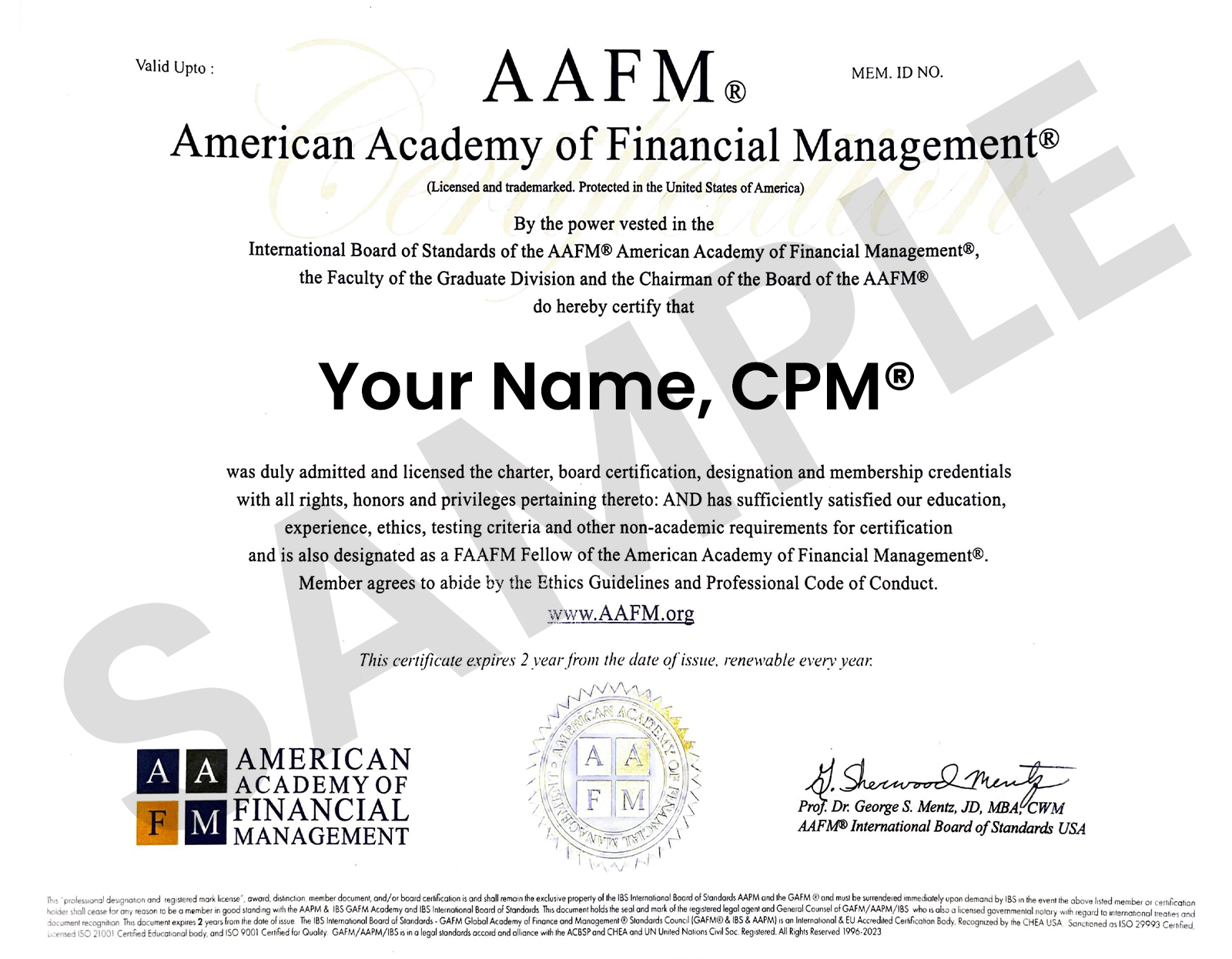
Every CPM® charter can be verified online by employers and clients at AAFM India's official verification page. Your designation is a credential, not a claim — and verification is what separates the two. Use the CPM® mark after your name on your resume, LinkedIn, business card and client communication. Certificates are issued from the USA under American Academy of Financial Management® international standards. CertificationValidityChecks

One route, one charter

Eligibility & pathways

Who can enroll

Anyone who has passed Class 12 (10+2) can register for the programme. No prior finance background is assumed — the curriculum builds from the fundamentals.
What certification requires

A bachelor's degree from a recognised institution is required at the time the certification is conferred, so final-year students can enrol now and be certified after graduating. Candidates must also pass the CPM® examination and agree to the AAFM® code of ethics.

Registration is valid for 365 days from activation. Certification must be completed within three years of first registration. Registration can be renewed from your candidate account.

Earn it, don’t buy it

The certification exams

CWM® is a designation you earn. Here is exactly how.

Question
Answer
How many exams?
One examination covering the full 10-unit curriculum.
Exam duration
3 hours.
Where is it booked?
Through AAFM® India's authorised testing process.
Certificate
Issued from the USA under American Academy of Financial Management® international standards.

The counsellor call, replaced

Frequently asked questions

Everything you'd normally ask a counselor, answered here.

General

CPM® is a professional certification in investment and portfolio management, conferred under American Academy of Financial Management® standards and delivered in India by AAFM® India. It covers a 10-unit curriculum running from economic analysis and security valuation through asset allocation, alternatives and performance evaluation to India's portfolio management regulations.

CWM® is built around managing a client's overall financial life — planning, tax, insurance, estate transfer and advisory. CPM® is built around the investment decision itself: how portfolios are constructed, allocated, monitored and evaluated. If your work centres on analysing and managing investments, CPM® is the closer fit. Many professionals eventually hold both.

Research analysts, dealers, PMS and asset management executives, brokers and sub-brokers, investment consultants, RIAs and distributors moving into investment management, CAs and CSs extending into investments, and finance students targeting analyst or buy-side roles.

A general finance course teaches topics. CPM® teaches a process. The units are sequenced the way a portfolio manager works — establish the environment, set the policy, analyse the security, allocate the assets, measure the outcome — so the knowledge connects rather than sitting in separate boxes.

To build an investment policy statement; to analyse economies, industries, companies and financial statements; to value equity using multiple models; to allocate across asset classes using asset pricing frameworks; to place alternatives and real estate within a portfolio; to rebalance and evaluate performance; and to work within SEBI's portfolio management framework.

No. The curriculum begins with the fundamentals of the financial system and investment vehicles before moving into analysis and portfolio construction. A financial calculator is useful throughout.

Online, through the AAFM® India learning portal — 109 lessons across 10 units, accessible on mobile and desktop, with unit-wise quizzes. Access activates within 24 hours of enrolment and runs for 12 months.

This depends on your pace. Registration is valid for 365 days and can be renewed, and certification must be completed within three years of first registration.

Anyone who has passed Class 12. A bachelor's degree is required at the point the certification is conferred, so final-year students can begin now.

One examination of three hours covering the full curriculum, booked through AAFM® India's authorised testing process.

₹28,000 + 18% GST, which comes to ₹33,040. This includes your registration and 12 months of courseware access.

Investment research, portfolio management, asset management, portfolio management services, investment advisory, alternative investments and capital markets roles. CPM® builds knowledge relevant to these areas; AAFM® India does not guarantee employment or salary outcomes.

All fees are non-refundable once paid. We state this upfront so you can decide with complete information.

Part of a globally certified professional framework

CPM® is awarded under American Academy of Financial Management® standards, with certificates issued from the USA. Examinations are booked through authorised testing partners.

Not sure whether CPM® or CWM® fits you?

If your work centres on investments and portfolios, CPM® is the specialist route. If it centres on the client's overall financial life, CWM® is. A career expert can talk it through in ten minutes.

Talk to a Career Expert →

Self-paced or live

Choose your Study Mode

Choose the study mode that works best for Chartered Portfolio Manager® (CPM®) Certification. Your selected course access and applicable fees are shown below.

Study on your own schedule
₹34000
+ 18% GST
₹40120 payable today
  • 1 Year Registration
  • 1 Year Online Courseware Access
  • 109 Lessons across 10 Units
  • Unit-wise Quizzes
  • Access on Mobile and Desktop
  • Dedicated Learning Support

Complete your enrollment

Selected: Instructor Led ClassesSelect pathway and courseware

Program fee₹34000
GST (18%)
Total payable₹40120

Join a global network of 300,000+ certified professionals.

Everything you need to decide is on this page — the full curriculum, the exam, the fee and where the knowledge applies. Enrollment takes five minutes and your learning portal opens within 24 hours.

Enroll in CPM® Today → Standards · Trust · Excellence in Financial Education
₹34000 + 18% GST
₹40120 GST-inclusive
Includes:
  • 1 Year Registration
  • 1 Year Online Courseware Access
  • 109 Lessons across 10 Units
  • Unit-wise Quizzes
  • Access on Mobile and Desktop
  • Dedicated Learning Support
Compare this course with other →

Request a callback

Leave your details and an advisor will get in touch.

We typically respond within 2 business hours.

From ₹34000+ 18% GST · ₹40120 total
See Fees & Enroll
×

Enquire Now