What Are REITs and InvITs in India? A Beginner’s Guide
 Written by Tanvi Sharma - 10 Hours Ago
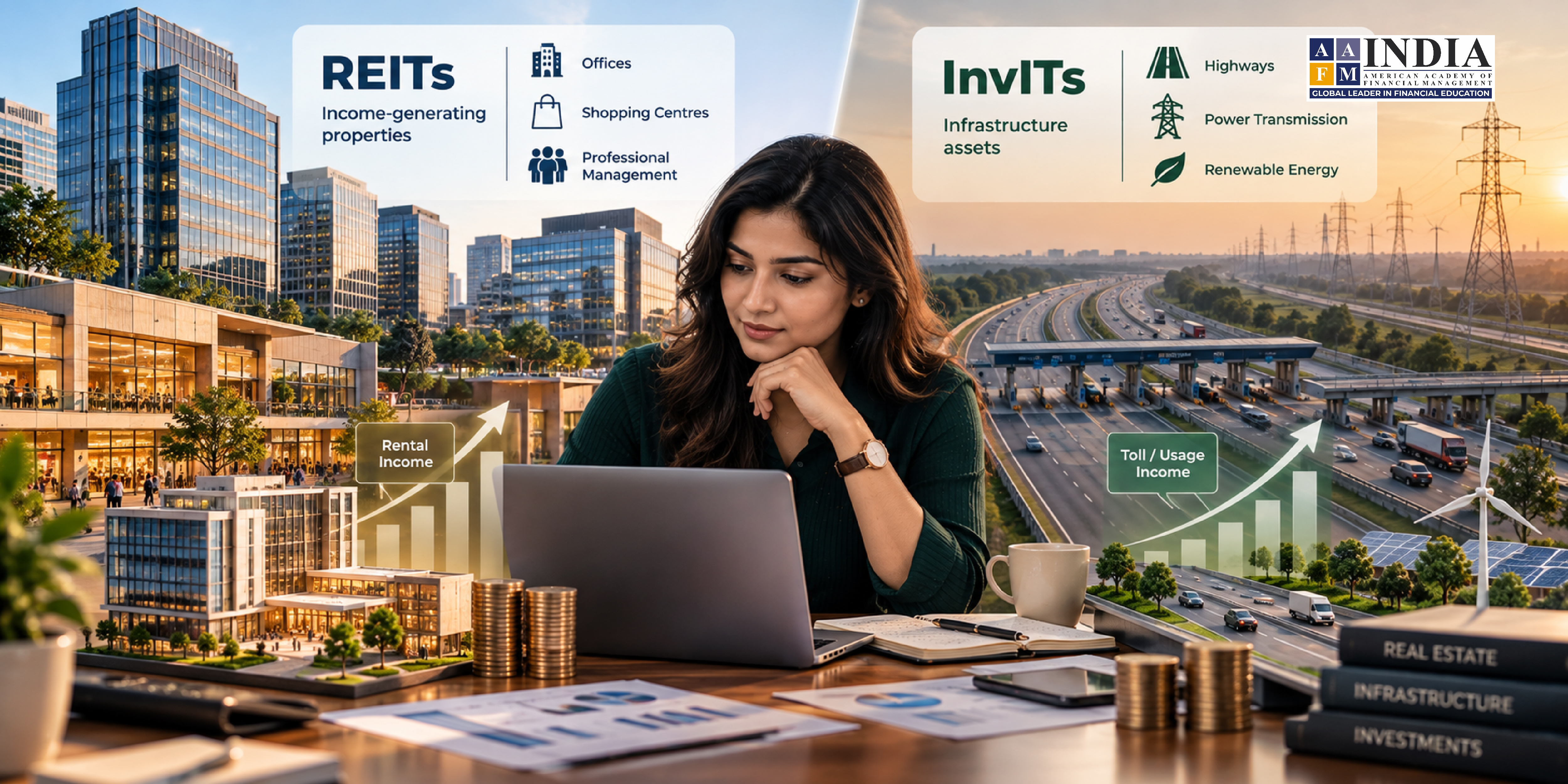
REITs and InvITs in India: A Beginner's Guide to Alternative Real Estate Investing
Earning rental income sounds appealing. Buying and managing a property takes more thought.
Neha realised this while exploring commercial properties in Pune. Beyond the price, she had to consider tenants, repairs and months without rent.
Could she invest a smaller amount and leave the management to professionals?
Her search led her to REITs and InvITs in India. These trusts allow people to invest in income-generating properties and infrastructure without buying an entire asset.
Investors buy units and may receive a share of the income these assets generate. However, neither the income nor the investment value is guaranteed.
To understand this better, let’s first look at what REITs and InvITs are and the assets each invests in.
What Are REITs and InvITs?
Both pool money from several investors to invest in large assets. The main difference is the type of asset they hold.
What Are REITs?
Real Estate Investment Trusts (REITs) invest in income-producing assets, such as office parks and shopping centers.
Consider how an office building is rented out to various organizations. By investing in REITs, you are involved in earning from the property without owning the office.
The units of the trust are owned by you, and not the office building in particular.
It is managed by professional fund managers who look after its maintenance and leasing.
What Are InvITs?
Infrastructure Investment Trust, or InvITs, invest in infrastructure assets such as highways, power transmission lines and renewable energy projects.
Their income depends on the assets they hold—for example, toll collections from a road or charges for making a power transmission network available.
These assets often operate under long-term agreements, although their income still depends on the contract terms and project performance.
While REITs connect investors with property income, InvITs provide access to infrastructure income.
How Do REITs and InvITs Work?
Both pool investors’ money, but earn income from different assets.
How Do REITs Work?
Let's take an example of a REIT that owns an office park leased out to various companies.
Rent is collected from these companies, and professional management handles the lease administration, property management, and other expenses. After making adjustments to expenses and income, the amount of money left for distributions is determined and distributed to the unitholders.
In such cases, long-term leases and rent increases could contribute towards earning income. Vacant offices or late rents could lower the amount of distributable money.
For instance: If the REIT pays ₹6 per unit and you have 100 units, you will get ₹600.
How Do InvITs Work?
Imagine an InvIT that invests in the operation of a toll road.
The users of the road pay the tolls for the use of the road. Road management is the responsibility of the project manager, while investment management falls under the domain of the investment manager. After deduction of cost and adjustments, the net cash can be distributed to unitholders.
For this project, traffic levels and toll rates influence revenue. Maintenance costs and the remaining period of the road concession—the right to operate it—also affect future cash flows.
For example: If the InvIT declares ₹4 per unit and you hold 100 eligible units, you receive ₹400 before applicable taxes.

REITs vs InvITs: What Is the Difference?
|
Aspect |
REITs |
InvITs |
|
Underlying assets |
Income-generating properties such as offices and shopping centres |
Infrastructure such as roads, power transmission networks and renewable energy projects |
|
Who makes the payments? |
Tenants occupying the properties |
Road users, power purchasers, utilities or other contractual counterparties |
|
Management responsibilities |
The manager oversees investments, leasing and property management |
The investment manager oversees investments and finances; the project manager handles project operations |
|
Income growth drivers |
Rent increases, higher occupancy, lease renewals and acquisitions |
Traffic growth, contractual payment increases, improved operations and acquisitions |
|
Income visibility |
Depends on lease duration, tenant quality and timely collections |
Depends on contract terms, project usage, asset availability and payment collection |
|
Major operating expenses |
Building maintenance, repairs, insurance and property management |
Project maintenance, repairs, insurance and operating costs |
|
Key operational risks |
Vacant space, tenant defaults and weaker rental demand |
Project disruptions, lower usage, equipment failures and unexpected maintenance |
|
Borrowing risk |
Debt repayments and financing costs can reduce cash available for distributions |
Debt repayments and financing costs can similarly affect distributions |
|
Interest rate sensitivity |
Higher rates can increase borrowing costs and affect unit valuations |
Higher rates can also increase borrowing costs and affect unit valuations |
|
Diversification |
May spread investments across properties, tenants and locations |
May spread investments across projects, locations and infrastructure sectors |
|
Distributions |
Depend on distributable cash flows; amounts are not guaranteed |
Depend on distributable cash flows; amounts are not guaranteed |
|
Liquidity |
Listed units can be traded, but ease of selling depends on trading activity |
Access and liquidity vary between publicly offered and privately placed InvITs |
|
Tax considerations |
Depend on distribution components and gains from selling units |
Also depend on distribution components and gains from selling units |
Benefits of Investing in REITs and InvITs
REITs and InvITs allow investors to access large properties and infrastructure projects without purchasing or managing these assets themselves.
- Smaller starting investment: Investing in units requires a significantly lower amount of capital as compared to investing in real estate property. Participation is easy without requiring you to commit a substantial amount of your funds.
- Potential additional income: Payments from trusts are made to the unitholders. The payments can enhance your income levels though the amounts may vary and are not assured.
- Professional management: Expert management will run the business. You will not have to deal with the tenants or manage the property yourself.
- Diversification: A diversified portfolio can be managed by the trust. This will limit the dependence of the trust on one asset though many portfolios tend to be concentrated in certain industries or geographic locations.
- Easier buying and selling: Units that are listed on the stock exchange can be easily purchased or sold. However, selling the units at your desired price depends on how well they trade in the market.
- Access to information: Reports from the financial statements and operations will help you know about the performance, debt and distributions of the assets.
Read More :- Gig Economy & Freelancer Finance: Tax, Insurance & Retirement Planning
What Are the Risks of REITs and InvITs?
Professional management makes investing convenient, but it does not remove risk. Before investing, consider what could affect both your payouts and the value of your units.
- Market price fluctuations: Market price levels can fall despite generating returns. The sale at this time may lead to losses.
- Interest rates and borrowing: Increased rates of interest and borrowings can adversely impact valuation. Large borrowings for repayment may not be available for distribution.
- Property and project performance: Idle properties/ offices or default by tenants can affect the income generation from REITs. Reduced footfall or disruption in operations of equipment/projects can affect InvITs' income.
- Dependence on a few assets: When the trust has its income dependent on a single tenant, project, or sector, the income generated is bound to be adversely affected.
- Contract and policy changes: Expiry of lease periods, temporary operating rights, and changes in toll or tariffs can affect future income levels.
- Limited liquidity: Less trading may create difficulties in the sale of units at your preferred price.
How to Invest in REITs and InvITs
How to Invest in REITs
Open a demat and trading account with a registered broker and complete your KYC. You can then search for a listed REIT on your broker’s platform, select the quantity and place a buy order. Once settled, the units appear in your demat account.
You can also apply during a REIT public issue, following its application process and minimum investment requirements.
How to Invest in InvITs
The process is similar for publicly offered, listed InvITs. Buy eligible units through your trading account or apply during a public issue under its terms.
Check the InvIT’s category before proceeding. Privately placed InvITs have different investor eligibility and investment requirements.
What to Check Before Investing in REITs and InvITs
What to Check Before Investing in REITs
- Occupancy and tenants: Examine how much space is leased and whether a few tenants contribute most rental income.
- Lease duration: Check when major leases expire, as vacancies or renegotiations can affect collections.
- Finances and valuation: Compare rental growth with expenses, borrowing costs and repayments. Assess the unit price against net asset value and earning prospects.
What to Check Before Investing in InvITs
- Revenue model: Understand whether income depends on traffic, electricity generation or contractual availability payments.
- Project life: Review remaining operating rights, contract conditions and major maintenance commitments.
- Cash flows and payouts: Examine payment delays, debt repayments and distribution components. Capital repayment should not be mistaken for income.
For both, review the manager’s track record, latest financial reports and trading activity. A high distribution yield alone does not establish a good investment.
How Are REITs and InvITs Taxed?
A payout can contain different components, so the entire amount is not necessarily taxed alike. Here is how this broadly works for resident individual investors.
Taxation of REITs
- Interest: Generally taxable at your applicable income tax slab rate.
- Dividends: May be exempt or taxable, depending on the underlying company’s tax regime and applicable conditions.
- Direct rental income: Rent passed through from properties owned directly by the REIT is generally taxable at applicable rates.
- Capital repayment: Special rules determine whether it reduces your acquisition cost or becomes taxable.
- Sale of units: Profits attract capital gains tax based on the holding period, transaction conditions and adjusted acquisition cost.
Taxation of InvITs
- Interest: Generally taxable at your applicable slab rate.
- Dividends: Exemption depends on the underlying company’s tax regime and applicable conditions.
- Capital repayment: Should not automatically be treated as tax-free; it can affect acquisition cost or become taxable under special rules.
- Sale of units: Profits are subject to applicable capital gains provisions.
Unlike REITs, InvITs do not have the specific pass-through category for directly earned property rent. Check the trust’s distribution statement to identify each component before calculating tax.
Conclusion
REITs and InvITs offer access to real estate and infrastructure without purchasing or managing an entire asset.
The key is understanding what sits behind the units.
Before investing, examine the assets, borrowing, cash flows and tax treatment. Regular distributions may be appealing, but their sustainability matters more than a high headline yield.
Whether these investments suit your portfolio depends on your financial goals, investment horizon and comfort with changing payouts and market prices.
Frequently Asked Questions
Q1. Do REITs and InvITs offer guaranteed returns?
Ans. Not necessarily. Distribution is determined by the cash available, and unit prices may either increase or decrease. You may get less dividends or even incur losses when you sell.
Q2. Do I own a property when I buy REIT units?
Ans. You own units in the trust, which give you an interest in its portfolio. You do not directly own a specific office, shop or building.
Q3. Do REITs and InvITs pay monthly income?
Ans. Not always. Payment schedule is dependent on the trust. Look at its payment policies to see how you can plan your expenses according to that.
Q4. Is a higher distribution yield always better?
Ans. No. High yield might be because of declining unit price or even includes capital repayment. Consider sustainability of payout, quality of debt and assets.
Q5. Can I sell my units whenever I need money?
Ans. Exchange traded units may be made available for purchase at market hours. This will be determined by availability of the buyers, trading as well as the price you set.
Author by
Comments (0)
Search
Popular categories
Wealth Management
14Finance
13Financial Planning
7Finance Certifications
5Investing
4Estate Planning
3Latest blogs
What Are REITs and InvITs in India? A Beginner’s Guide
10 Hours Ago 0 12

Gig Economy & Freelancer Finance: Tax, Insurance & Retirement Planning
3 Days Ago 0 52

ESG Investing in India: A Guide for Investors & Wealth Managers
8 Days Ago 0 88
Write a public review